The Zone of Apocalypse
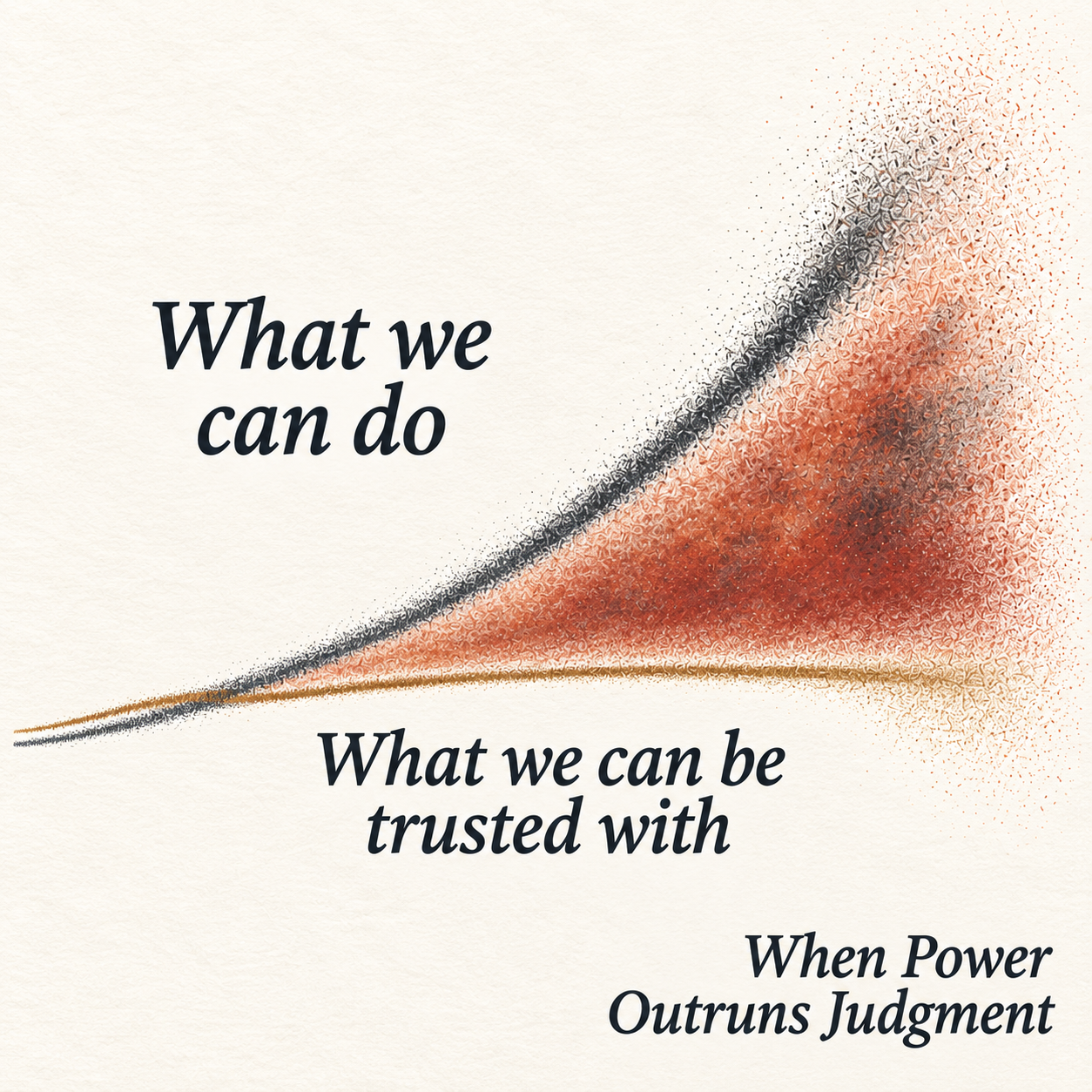
Our power is growing exponentially. Our judgment isn't. AI may widen the gap.
The adolescent
Our species is about 300,000 years old. For nearly all of that time, the fastest a person could travel was the speed of a horse. Then, in 1903, two brothers flew. Sixty-six years later we walked on the Moon.
That is one kind of growth. Call it what we can do.
There is a second kind. It is the growth of what we can be trusted with. Foresight. Restraint. The habit of weighing other people's interests next to our own.
It grows too.
It has never once grown like that.
Draw both on one page and you get the picture at the top of this post. Two lines that start together and pull apart. I have carried that picture in my head for years.
The space between the lines is what I call the zone of apocalypse.
The top line can be measured. Transistors, energy, compute. The bottom line cannot. Nobody sells a gauge for wisdom. So this is a model, not a dataset.
But you already know the shape, because you have met it in a person. Any parent has.
A sixteen-year-old's appetite for speed and reward comes online years before the judgment that is supposed to govern it. The accelerator matures before the brakes. That is not a moral failing. It is a developmental fact, and it is why the most dangerous thing in a teenager's life is usually the teenager.
Carl Sagan had a name for a civilization in that condition. He called it technological adolescence.
He meant all of us.
The whole species.
One kid.
The keys
For most of history the gap was survivable. A bad king with a sword can only ruin so much.
That changed on a July morning in 1945, in the New Mexico desert.
For the first time, a single failure of judgment could be one we don't get to learn from.
That is my definition of the zone. Not the gap itself.
The part of the gap where mistakes stop being lessons.
We have lived there for eighty years.
It's fair to ask why we're still here.
Some of it was luck, and the historical record on that is not comforting. The rest was judgment, the collective kind. Treaties. Hotlines. Inspectors. Institutions built by people who distrusted each other and built them anyway.
Hold that thought.
It comes back.
What Keynes didn't predict
In 1930, with the world economy in ruins, John Maynard Keynes wrote a cheerful essay about his grandchildren.
He predicted that in a hundred years the standard of living would be four to eight times higher. He thought a work week of about fifteen hours would be plenty. His main worry was what we would do with all the free time.
On the wealth he was about right.
We solved the free time problem by not having any.
Keynes saw greed clearly. He expected that the love of money for its own sake would one day be seen as a kind of illness, something you refer to a specialist. His phrase was "a somewhat disgusting morbidity."
His bet was that we would put up with it a little longer, because it builds capital, and then drop it once we could afford better morals.
Here is what he did not predict.
We gave the morbidity tenure.
In 1970 Milton Friedman argued in the New York Times Magazine that the social responsibility of business is to increase its profits. I have written at length about what followed The $50 Trillion Decision. I won't repeat it here.
But there is a part of Friedman's argument worth remembering.
Executives, he wrote, should make as much money as possible while conforming to society's basic rules. Then he named the rules: "both those embodied in law and those embodied in ethical custom."
Ethical custom.
It is right there.
History mostly remembered the first part.
Over the following decades, shareholder primacy moved from an economic argument toward an operating system. Executive compensation shifted toward stock. Buybacks became commonplace. Boards became increasingly attentive to shareholder returns. Business schools taught generations of managers to think in the same language.
I was trained in it. Harvard Business School, then Wall Street.
Nobody argued for the doctrine.
Nobody had to.
The cleanest receipt comes from the CEOs themselves. In 1981 the Business Roundtable said companies should balance shareholders against everyone else with a stake. By 1997 it called shareholder interests the corporation's "paramount duty."
In 2019, 181 CEOs signed a statement reversing course again, promising responsibility to customers, employees, suppliers and communities as well as shareholders.
Researchers then checked what happened.
Buybacks stayed on the same upward trend.
Now, Friedman did not kill the fifteen-hour week. American working hours had stopped falling decades earlier. Keynes also assumed our wants were finite, and he had never met modern advertising.
I have.
It's my trade.
What changed during the Friedman era was the consolation prize.
From 1948 to 1973 we didn't get the leisure, but pay rose with productivity, almost one for one.
After that we got neither.
Friedman didn't take the weekend.
He took the raise.
Was that inevitable?
The OECD tracks how much we work. But it warns that differences in national methods make its annual totals unsuitable for direct comparisons between countries.
We cannot turn those figures into a neat count of how many weeks Americans could get back.
The question remains.
As our machines become more productive, how much of that gain should become income?
And how much should become time?
That is a choice about the rules.
The engine turns on us
The historian Melvin Kranzberg left us a useful law:
"Technology is neither good nor bad; nor is it neutral."
I'd split it this way.
The surplus a technology creates is neutral. It is just wealth, and who gets it is a choice.
The artifact is not neutral.
Somebody designs it.
And they design it to a spec.
For decades, more and more of our institutions learned to optimize against numbers: earnings, returns, clicks, engagement, growth.
Then, around 2010, machines built to optimize those numbers were pointed directly at us.
At our attention.
Which turns out to be where judgment lives.
A feed is not simply a town square that greedy people happen to misuse. It is a device designed to hold you, and outrage holds better than agreement.
I have bought the ad inventory.
I know what it is optimized for.
So what has it cost?
A list of bad news proves nothing. Better to ask the same questions, the same way, across decades.
In 1964, 77% of Americans trusted the federal government to do what is right most of the time. By September 2025 it was 17%.
In 1972, 46% of Americans said most people can be trusted. Now it is 34%.
In 2013, 30% of high school students reported persistent sadness or hopelessness. In 2021 it was 42%. In 2023, 40%.
Across twelve wealthy democracies over four decades, hostility between political parties rose most in the United States.
That sounds like a story of decline.
It isn't that simple.
Widely cited estimates put extreme poverty at 47% of humanity in 1981 and about 10% today. But those numbers depend on how poverty is defined and measured, and that dramatic account of progress is contested.
Progress matters. So does how we count it.
Rights widened for people who had none. And the best long-run measure of empathy among young Americans, after falling for thirty years, has been rising since 2009.
I believe all of it.
It sharpens the point.
The feelings are fine.
People are as capable of decency as they ever were.
What is failing is some of the machinery that turns private decency into public decisions.
Trust.
Shared facts.
Institutions.
In the adolescent, the heart is fine.
It's the judgment.
And there is another clue.
In six of those twelve democracies, partisan hostility fell.
Same phones.
Same internet.
The researchers point to causes particular to America, partisan cable news among them. Outrage was sold by the hour, at a profit, years before the smartphone.
The phone didn't invent that business.
It scaled it.
The problem was never the machine.
It was the spec.
Then came AI
Now add artificial intelligence, and every line in the picture moves at once.
Speed.
ChatGPT reached a hundred million users in two months. The European Union's AI law took more than three years, and had to be reworked mid-draft because the technology it regulates arrived while it was being debated.
Concentration.
No technology has ever cost this much to build.
That means its ownership begins unusually concentrated too.
Leverage.
This is the one that should keep you up.
Every time the gains from technology were broadly shared, labor had leverage. Capital needed people, and people could say no.
Earlier machines replaced muscle and pushed human beings toward thinking work.
This one does the thinking work.
And increasingly, it has a body.
Connect artificial intelligence to robots, drones, autonomous vehicles, warehouses and factories that can see, learn, coordinate and act, and the old distinction between physical and intellectual automation begins to disappear.
The machine can perceive.
It can reason.
It can act.
And the machines can talk to one another.
Every task a machine can perform for us is time a human being no longer has to surrender to that task.
Follow that arithmetic far enough and something astonishing appears.
Freedom.
Not freedom as a slogan. The most literal kind there is: the ability to decide what to do with your own time.
For most people who have ever lived, most waking hours were never really theirs. Survival claimed them. The field had to be planted. The ore had to be dug. The box had to be lifted, the truck driven, the books kept, the phone answered, the part inspected. Monday morning came whether you wanted it or not.
Keynes understood what rising productivity could ultimately buy us.
Not more stuff.
Our time back.
He may have been early.
He may not have been wrong.
The fifteen-hour week is no longer a fantasy about human beings becoming less productive. It is becoming technologically conceivable because we may become unimaginably more productive.
Civilization has always required toil.
We may be approaching the technological capacity to break that bargain.
Think about what that means.
Not unemployment.
Liberation from unnecessary work.
More time to raise children. Care for parents. Learn something for no economic reason. Make music badly. Coach Little League. Start a company. Build furniture. Study physics. Know your neighbors. Sit with someone who is dying. Waste an afternoon.
Or do absolutely nothing.
Because the time is yours.
Be human.
This should be among the happiest developments in the history of our species.
And yet we are terrified of it.
That tells us something.
The terror is not that the machines will do the work.
For ten thousand years, that is exactly what we have wanted our machines to do.
The terror is that we built a society in which access to the abundance produced by the machines still depends, for most people, on selling their labor.
Remove the labor before changing that rule and liberation looks exactly like destitution.
That is the paradox sitting underneath the AI debate.
There is no evidence yet of economy-wide AI job displacement.
None.
That matters.
But Stanford researchers using ADP payroll data found something narrower and more disturbing. Employment for workers aged 22 to 25 in the most AI-exposed jobs is about 19% below where it would be if it had kept pace with their peers, and the gap is widening.
It happens mostly through hiring that never occurs, not layoffs.
Nobody is fired.
The door just doesn't open.
So put the argument conditionally.
If the enormous gains promised by AI arrive, the rules will help determine who receives them.
If they don't arrive, we may be witnessing one of history's great misallocations of capital—which would itself be a story about what happens when institutions optimize around a single objective.
And the upside is real.
I build with these tools every day.
They are astonishing.
A patient tutor for every child on Earth is now an engineering problem, not a dream.
AI could accelerate drug discovery, science, education and human creativity in ways we can barely model.
The surplus is neutral.
It will go where it is pointed.
The loop
Predictions of doom have a poor record.
Malthus was wrong. Ehrlich was wrong.
They were wrong, in part, because they underestimated our ability to respond.
We noticed problems.
We argued.
We adapted.
We built something.
Remember the treaties.
That is what worries me now.
The thing that responds is the thing being worn down.
Trust, shared facts and institutions are how a civilization exercises judgment.
And some of the most powerful engines we have built now make money by consuming them.
Look at the picture again, with one addition.
An arrow from the top line, pressing down on the bottom one.
Power is not merely outrunning judgment.
It may be eroding it.
I cannot give you a meter reading for that arrow. It is the argument of this essay, not a measurement.
But consider what it means.
We are racing to solve AI alignment: how to ensure increasingly capable machines remain aligned with human values.
There is an older alignment problem upstream.
What are the institutions deploying those machines aligned with?
If the answer is engagement, profit, power, quarterly returns or winning the next election, then making the machine more intelligent does not solve the problem.
It makes the optimization better.
No teenager ever owned a device designed to keep him from growing up.
We do.
The machine is not the apocalypse.
The rule is.
The turn
Capitalism does not run on greed.
It runs on hope.
Every share price is a bet that the future will be better than the present.
Keynes understood this too. In 1936 he called it animal spirits. Investment depends on confidence in a future nobody can actually know.
And the economy's real investors are not just institutions moving billions across screens.
They are the student who borrows for a degree.
The couple who sign a thirty-year mortgage.
The founder who quits a job.
The parents who decide to have a child.
Every one of those is a bet on the future.
That is why the 19% employment gap among young workers matters beyond the number of jobs involved.
A first job isn't just income.
It is the first rung of a ladder.
Remove enough first rungs and something larger changes.
Hope has gone K-shaped.
When broad hope disappears, capital doesn't stop moving.
It changes what it builds.
Less that creates.
More that extracts and protects.
The economists Samuel Bowles and Arjun Jayadev call one version of this "guard labor": the resources societies devote to protecting property, enforcing claims and managing the consequences of inequality instead of producing new things.
No hope, no growth.
Only moats.
And now the two lines in the picture meet again.
Because the top line ultimately depends on the bottom one.
Science requires trust.
Markets require trust.
Investment requires trust.
Democracy requires enough shared reality for losing an argument to be preferable to destroying the system.
Technology requires institutions capable of deciding where it should point.
Starve judgment long enough and eventually you starve the future all that money is betting on.
None of this is physics.
1948 was not a miracle.
The rules are choices.
I've laid out some of the ones I would choose elsewhere The $50 Trillion Decision and AI, Productivity, and the Choice.
But the first choice comes before policy.
It is deciding what we are trying to optimize.
I have four children.
In a way, Keynes wrote his essay for them.
He did the math, and the math was right.
He left the ethics as an exercise for the grandchildren.
We are the grandchildren.
We may finally possess the power Keynes imagined: enough productive capacity to loosen the ancient chains of toil.
But realizing his prediction requires another kind of acceleration.
Not more compute.
Not more robots.
Not another trillion dollars of capital expenditure.
An acceleration in the other line.
In what we can be trusted with.
Because a civilization capable of producing abundance without requiring everyone's labor has to answer a question no civilization before it has seriously faced:
What do we owe one another when we no longer need one another's work?
That is not really a question about artificial intelligence.
It is a question about us.
For four centuries we have repeated Hamlet's question as though it belonged to one troubled man:
To be, or not to be?
We have reached the point where it belongs to the species.
We have the power to build a world in which human beings are finally free to spend more of their brief lives being human.
We also have the power to build something very different.
The machines cannot make that choice for us.
They should not.
To be or not to be.
That is the choice.
I choose to be.
2B.
Sources & Documentation
- Keynes, Economic Possibilities for our Grandchildren
- What Milton Friedman Really Said — Law & Liberty
- Business Roundtable: Five Years On
- Roosevelt Institute: Shareholders First
- Glambosky et al.: research on the Business Roundtable statement
- Pew: Public Trust in Government, 1958–2025
- Visual Capitalist: Trust in U.S. Government Over 70 Years
- Pew: Americans’ Trust in One Another
- JED: CDC Youth Risk Behavior Survey trends
- Konrath et al.: Empathy Trends, 1979–2018
- Boxell, Gentzkow & Shapiro: Cross-Country Trends in Affective Polarization — NBER
- The Conversation: Has extreme poverty really plunged since the 1980s?
- OECD: Hours worked and methodological limitations
- Stanford Digital Economy Lab: Canaries, August 2026
- Yahoo Finance: AI capital expenditure plans
The chart is a conceptual model, not measured data. The empathy study covers 1979–2018; its reported recovery begins after 2009. The poverty estimate is contested, and OECD annual hours totals are not suitable for direct country-level comparisons.
David Gould
Founder
Harvard MBA, entrepreneur, and father of four. Founded 2B.org to ensure the AI productivity revolution benefits everyone—not just shareholders.